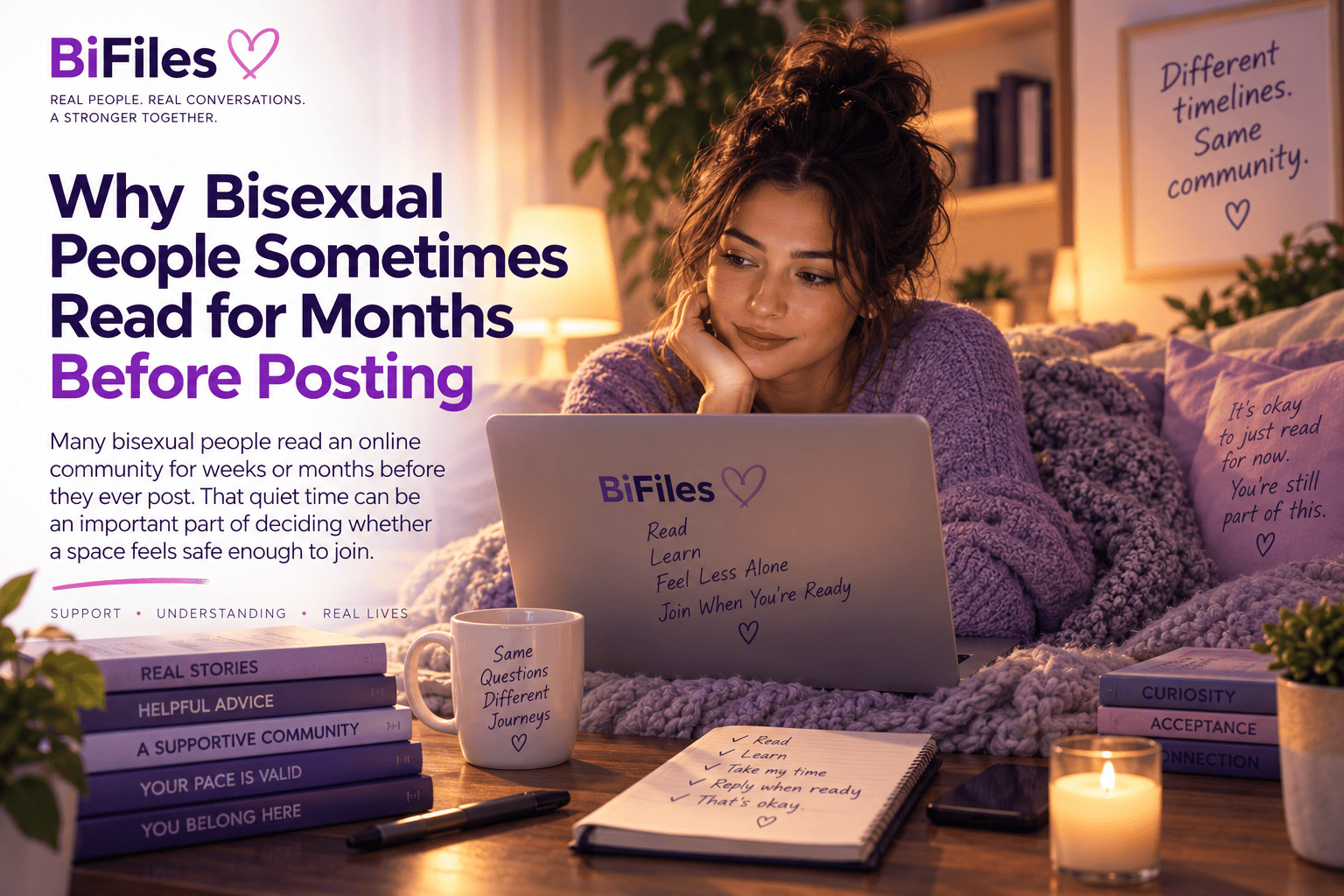
Joining an online community does not always begin with introducing yourself.
Sometimes it begins much more quietly.
You find a discussion through Google. You read someone else’s question. You come back a few days later. Maybe you start recognizing names, noticing how people respond to difficult topics, or checking whether personal stories are treated with respect.
Weeks can pass before you ever write a reply.
For bisexual, bi-curious and questioning people, that period of quietly reading can be especially important. It is not necessarily hesitation that needs to be fixed. Sometimes it is how someone decides whether a community feels safe enough to become part of.
Reading first can be a form of participation
Online communities often measure participation through visible activity: posts, replies, likes and new member introductions.
But there is another group that is much harder to see.
They are reading.
Someone may be learning from a discussion about coming out without being ready to talk about their own situation. Another person may be comparing their experiences with stories from people who recognized their bisexuality later in life. Someone else may simply be checking whether people like them are taken seriously.
None of that appears as activity on a forum.
But it can still matter.
Before sharing something personal, people often watch how others are treated
Posting about sexuality can feel very different from posting about a hobby, a television show or a technical problem.
A question about bisexuality might involve a relationship, family, religion, privacy, attraction, shame, confusion or something the person has never said out loud before.
Before sharing that kind of information, it makes sense to look for signals.
- Do people answer questions respectfully?
- Are questioning people pressured to choose a label?
- Are bisexual experiences taken seriously?
- Do disagreements stay civil?
- Are people pushed toward private messages or sexual conversations?
- Can someone say “I don’t know yet” without being dismissed?
- Does moderation actually protect the tone of the community?
A person may need to see those answers repeatedly before trusting the space.
You may also be trying to understand yourself
Not everyone arrives in a bisexual community with a clear identity and a finished story.
Some people are still asking themselves basic questions.
- Does this attraction actually mean something?
- Can I be bisexual if I have only dated one gender?
- Why does my attraction seem stronger at some times than others?
- Am I bisexual, bi-curious, queer, or do I need a label at all?
- What would accepting this part of myself change?
Reading other people’s experiences can give someone language for feelings they have not yet been able to describe.
That does not mean another person’s story provides the answer. Bisexual experiences are too varied for that.
But seeing several different experiences side by side can make it easier to understand your own.
Sometimes privacy is the main reason
There are also practical reasons why someone may prefer to read rather than post.
They may share a device with a partner or family member. They may not be out. They may live somewhere where being openly bisexual could affect their relationships, housing, work, religion or personal safety.
Even in safer circumstances, someone may simply not want their most personal questions attached to an account yet.
Quiet access matters because people should be able to learn something before deciding how much of themselves they want to share.
A good community should not punish quiet people
There can be pressure online to introduce yourself immediately, become active, or prove that you belong by contributing.
That approach can work against the people who need community most.
A safer community leaves room for different levels of participation.
- You can read without explaining yourself.
- You can reply to someone else before starting your own topic.
- You can ask a small question instead of telling your whole story.
- You can change how much you share over time.
- You can decide that reading is enough for now.
Participation does not have to begin with disclosure.
The first reply can still feel surprisingly difficult
After months of reading, writing a first reply can feel strangely significant.
You may have seen dozens of conversations by then, but pressing “Post” means becoming visible in a way that reading does not.
That first contribution does not need to be a coming-out story or a detailed introduction.
It might simply be:
- “I relate to this.”
- “This helped me understand something.”
- “I’ve wondered about this too.”
- “Thank you for sharing this.”
Small replies count.
And sometimes they are easier because they let someone enter a conversation without immediately making themselves the subject of it.
You do not have to wait until you have everything figured out
There is another reason people sometimes stay quiet: they think they need a clear conclusion before they are allowed to speak.
But uncertainty is a valid place to start.
You do not need a perfect label, a relationship history that proves anything, or a finished explanation of your sexuality before asking a question.
A community can be useful while you are still figuring things out.
And if you are not ready to post yet, that is fine too.
Read quietly. Reply when you’re ready.
Some people join a community in five minutes. Others need five months of reading before they feel comfortable saying anything.
There is no correct timeline.
If reading other people’s conversations helps you feel less alone, understand yourself more clearly, or decide whether BiFiles feels like the right place for you, then that time already has value.
And if one day you decide to join a discussion, your first reply does not need to be impressive.
It only needs to be yours.
Explore at your own pace
You can browse the BiFiles Forum without needing to begin with a personal introduction.
If you are looking for shorter answers before joining a discussion, you can also explore the BiFiles Support & FAQ.


